
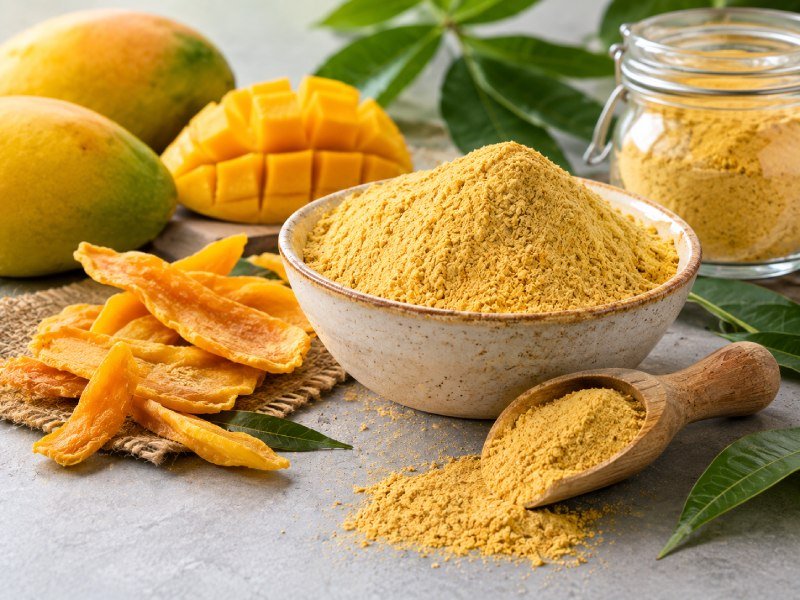
Understanding Dried Mango Powder Benefits & Manufacturing helps food businesses choose the right ingredient for consistent flavour, acidity and product performance. Also known as amchur powder, it is made from unripe mangoes that are processed and dried before being ground into a fine powder.
For manufacturers, restaurants, seasoning brands and exporters, sourcing from reliable dehydrated vegetable powder manufacturers india can make a difference in consistency, shelf life and batch performance.
What Is Dried Mango Powder?
Dried mango powder, or amchur, is a dry food ingredient prepared from raw mangoes. Its naturally tangy and slightly fruity profile makes it useful when a formulation needs acidity and mango character without adding fresh fruit.
Unlike fresh mango, the powdered format is easier to portion, transport, store and incorporate into dry food formulations.
Its application can range from traditional Indian cooking to commercial seasoning blends, snack coatings, chutneys, instant foods and ready-to-cook products.
Dried Mango Powder Benefits & Manufacturing, Uses
1. Adds Natural Tangy Flavour
The most important functional benefit is its sharp, sour taste. It can help create the tangy profile expected in spice blends, snacks, chutneys and savoury foods.
2. Easy to Handle and Store
Because it is a dry ingredient, amchur powder does not require the same handling as fresh mango. This makes it practical for food processors working with standardised recipes and larger production volumes.
3. Useful in Dry Formulations
Powdered mango can be blended with spices and other dry ingredients. This makes it particularly suitable for seasoning manufacturers, snack producers, instant food companies and private-label brands.
4. Supports Consistent Formulation
Using a defined specification allows manufacturers to control the amount of mango powder added to each batch. Consistency in particle size, moisture, flavour and colour is therefore important when sourcing commercially.
Culinary and Industrial Uses of Amchur Powder
Indian Spice Blends
Amchur is commonly used in spice formulations where a sour, fruity note is required. It can be combined with chilli, cumin, coriander, black salt and other spices.
Snacks and Namkeen
Snack manufacturers can use dried mango powder in seasoning systems for namkeen, chips, roasted snacks and savoury mixes. The powder can contribute to the characteristic tangy flavour consumers expect.
Chutneys and Sauces
Amchur powder can be incorporated into chutney mixes, sauces, marinades and savoury preparations. Its dry format also makes it useful for instant or ready-to-use formulations.
Ready-to-Cook and Instant Foods
Food processors can add mango powder to instant soup mixes, spice sachets, meal kits, noodle seasonings and other convenience foods where controlled acidity and flavour are required.
HoReCa and Commercial Kitchens
Hotels, restaurants, caterers and cloud kitchens can use it when recipes require repeatable quantities of tangy mango flavour without preparing raw mangoes for every batch.
How Is Dried Mango Powder Manufactured?
The manufacturing process needs careful control because raw material quality directly affects the final powder.
A typical process includes:
- Raw mango selection – Suitable unripe mangoes are selected according to maturity and quality requirements.
- Cleaning and preparation – Mangoes are cleaned and prepared before processing.
- Cutting or slicing – The raw material is converted into suitable pieces for drying.
- Controlled dehydration – Moisture is reduced under controlled processing conditions.
- Grinding – Dried mango pieces are milled to the required powder specification.
- Sieving – The powder is screened to achieve a consistent particle size.
- Quality inspection – Parameters such as moisture, appearance, microbiological quality and other agreed specifications are checked.
- Packaging – The finished powder is packed in suitable moisture-protective packaging.
A professional vegetable powder manufacturing company should have defined controls across these stages rather than treating grinding and packing as the only important steps.
How to Choose a Reliable Indian Supplier
An experienced Indian spices supplier should be able to clearly explain its sourcing, processing, quality-control, packaging and batch-traceability practices.
Ask for a product specification before placing a large order. If the powder is going into a seasoning, snack, sauce or instant food, trial the ingredient in the actual formulation rather than judging it only by appearance.
This approach helps buyers identify differences in flavour intensity, flow, colour, hydration and final product performance before committing to regular procurement.
Final Takeaway
Dried mango powder is more than a traditional souring ingredient. Its tangy flavor, convenient dry format and versatility make it suitable for seasonings, snacks, sauces, instant foods, HoReCa and food manufacturing.
For commercial buyers, choosing the right grade and consistent quality is essential. Chhatariya Foods Pvt. Ltd. offers dried mango powder for different food applications, helping businesses source a reliable ingredient with consistent specifications and quality.
FAQ
1. What are the main dried mango powder benefits for food manufacturers?
Dried mango powder provides a convenient source of tangy mango flavour in a dry format. It is easy to measure, blend, transport, and store, making it suitable for seasoning mixes, snacks, sauces, instant foods, chutneys, and other commercial food formulations requiring consistent acidity and flavour.
2. Is dried mango powder the same as amchur powder?
Yes. Dried mango powder is commonly known as amchur powder in India. It is generally produced from unripe mangoes that are dried and ground. The final flavour, colour, particle size, and acidity can vary depending on raw material and processing specifications.
3. Where can bulk dried mango powder be used?
Bulk dried mango powder is suitable for snack seasonings, namkeen, spice blends, chutneys, sauces, marinades, instant foods, ready-to-cook products, and commercial kitchens. Manufacturers should select the specification based on the required flavour intensity, particle size, moisture level, and formulation requirements.
4. How is dried mango powder manufactured?
Dried mango powder manufacturing generally involves selecting suitable raw mangoes, cleaning and preparing them, cutting or slicing, controlled drying, grinding, sieving, quality inspection, and moisture-protective packaging. Process controls at each stage help maintain consistent flavour, particle size, and product quality.
5. How should I choose the best dried mango powder supplier?
Choose a supplier that provides clear specifications covering raw material, moisture, particle size, flavour, microbiological parameters, packaging, and traceability. For commercial procurement, request samples and documentation, then test the powder in your actual product before placing larger orders.
6. Can an Indian spices supplier provide dried mango powder for export?
Yes, Indian suppliers can provide dried mango powder for commercial and export applications, subject to product specifications and destination-market requirements. Export buyers should confirm documentation, packaging, batch traceability, quality parameters, and any regulatory requirements applicable to their target market.