
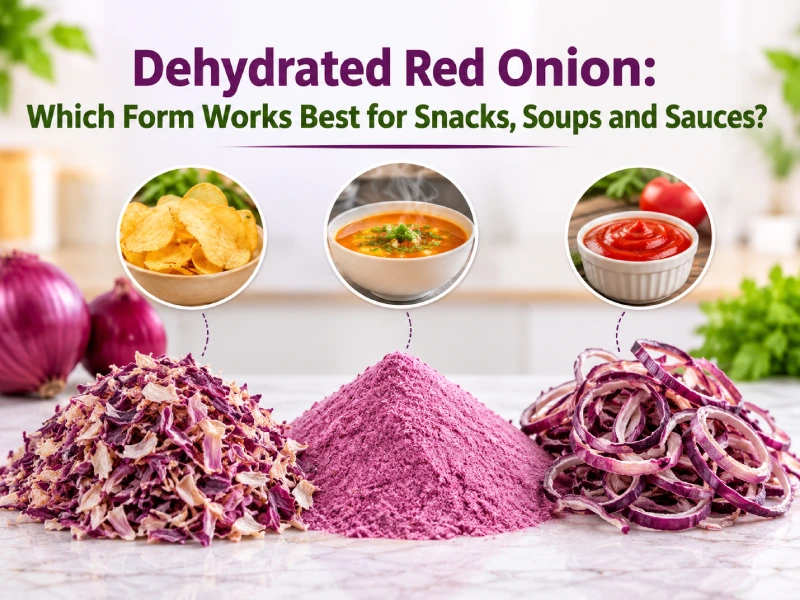
Choosing the right Dehydrated Red Onion for Snacks depends on the flavour, texture and processing needs of your finished product. Flakes, granules and powder may come from the same vegetable but each behaves differently during seasoning, mixing and cooking. Selecting the right form can improve ingredient distribution and help maintain consistent product quality.
For food processors, namkeen manufacturers, restaurants and sauce producers, the first step is to understand the available options. Explore Dehydrated Red Onion to assess which form may suit your application and bulk sourcing requirements.
1. Understanding the Main Forms of Dehydrated Red Onion
Dehydrated red onion is produced by removing moisture from prepared red onion under controlled processing conditions. The final form depends on how the dried material is cut, milled and graded.
Flakes: For visible onion texture
Red onion flakes work well when a recipe needs visible onion pieces rather than only onion flavour. They can suit selected savoury toppings, seasoning blends and dry mixes, depending on the required size and preparation method.
Before choosing flakes, check their size, colour uniformity and how they behave during storage and processing.
Granules: For balanced flavour distribution
Granules offer a smaller particle size than flakes while retaining more texture than a fine powder. They may suit spice blends, snack seasonings, savoury coatings and food formulations where a visible particle is useful but large pieces are not preferred.
Check how evenly the granules blend with salt, spices and other dry ingredients.
Powder: For smooth, even blending
Red onion powder is useful when a formulation needs onion flavour distributed throughout the product. It can suit seasoning systems, instant soup mixes, sauces and selected convenience foods.
Its fine texture can support even blending but particle size, moisture exposure and the intended mixing process should be considered to reduce clumping.
2. Which Form of Dehydrated Red Onion for Snacks?
For snack and namkeen manufacturers, the best option depends on how the onion ingredient is applied.
- Fine seasoning blends: Powder can help distribute onion flavour across a dry blend.
- Textured coatings: Granules may provide a more noticeable onion presence.
- Speciality toppings: Flakes may work when visible pieces are part of the product experience.
For example, a snack seasoning line may need powder for consistent coverage, while a speciality savoury mix may benefit from granules. These are starting points, not universal rules: oil levels, coating equipment, particle size and the full seasoning recipe affect performance.
If you are developing a red onion seasoning, test it on the actual snack base. Evaluate adhesion, flavour balance, visible particle distribution and changes during the expected shelf life.
3. Choosing Red Onion for Soups
Soups require a different assessment because the ingredient interacts with water, heat and other components.
Red onion powder may suit smooth soup mixes where a fine texture is preferred. Granules can be considered for soups that allow small vegetable particles, while flakes may suit formulations designed to include more visible ingredients.
During testing, check:
- How quickly the ingredient disperses or softens
- Whether lumps form during preparation
- How the onion flavour develops after cooking
- Whether the finished soup has the desired texture
Do not assume every dried onion product will dissolve completely. Dehydrated pieces may soften or rehydrate rather than dissolve, depending on their structure and the preparation method.
4. Selecting a Form for Sauces and Gravies
Sauces and gravies often need an even flavour profile and a consistent final texture. Powder can be useful in smooth formulations, particularly when the process includes suitable mixing and hydration steps.
Granules may work in thicker sauces or products where small onion particles are acceptable. Flakes are better considered when visible pieces are intentional and the recipe provides enough time and moisture for them to soften.
Before finalising a form, test the ingredient under production-like conditions. Check mixing behaviour, texture after holding, flavour consistency and whether the formulation requires extra processing to achieve the intended finish.
5. What Buyers Should Check Before Ordering
Food businesses comparing dried red onion from different suppliers should look beyond the product name.
- Specifications: Confirm the form, particle size, moisture limits and ingredient details.
- Sensory quality: Assess colour, aroma and flavour using a consistent test method.
- Quality documents: Request relevant specifications and available batch-related test reports.
- Packaging: Check pack integrity and suitability for the expected storage and transport conditions.
- Supply reliability: Confirm minimum order quantity, lead time and repeat-order consistency.
These checks matter for buyers sourcing from the growing vegetable powder market in India, particularly when ingredients must meet defined production or export requirements. Choose suppliers that communicate specifications clearly and provide documentation appropriate to the product.
6. Make the Choice Through Application Testing
A sample test is the most practical way to determine which form suits your product. Prepare small batches using the same recipe, ingredient quantities and processing conditions. Record flavour, texture, dispersion, appearance and any handling issues.
Chhatariya Foods offers dehydrated onion products for food businesses evaluating ingredient options. Buyers looking for Dehydrated Onion Mahuva can review the available dehydrated red onion range and discuss their intended application and specifications.
Final Thoughts
There is no single best form for every recipe. Powder is often a useful starting point for smooth blends, granules can balance flavour and texture and flakes provide more visible pieces. The right choice depends on your formulation, equipment and desired finished product.
Compare samples under realistic production conditions, confirm quality specifications and agree on acceptance criteria before placing a bulk order.
FAQ
1. Which form of dehydrated red onion is best for snacks?
Red onion powder is useful for fine seasoning blends, while granules can provide a more noticeable onion texture. Flakes may suit speciality toppings or mixes with visible onion pieces. Test each form on your actual snack base to assess flavour, adhesion and coating consistency.
2. Can dried red onion be used in soups and sauces?
Yes, dried red onion can be used in soup mixes, sauces and gravies. Powder may suit smooth formulations, while granules and flakes can add texture. The best choice depends on hydration, cooking time, mixing equipment and the texture required in the finished product.
3. What is the difference between red onion powder, granules and flakes?
The main difference is particle size and texture. Powder is finely milled for broad flavour distribution, granules retain a coarser texture and flakes contain larger pieces. Each form behaves differently during mixing and cooking, so select one based on the intended recipe and processing method.
4. How should food manufacturers evaluate vegetable powder suppliers?
Compare suppliers using product specifications, sample performance, colour, aroma, particle size, available quality documents and packaging. Also check minimum order quantities, delivery timelines and repeat-order consistency. Request samples and evaluate them under your actual production conditions before committing to a bulk purchase.
5. What should buyers check before ordering dehydrated red onion in bulk?
Confirm the required form, particle size, ingredient details, moisture specifications, packaging and storage guidance. Request relevant quality documentation and clarify delivery terms. For export orders, check destination-market requirements and labelling rules. Agree on product acceptance criteria before approving the commercial order.