
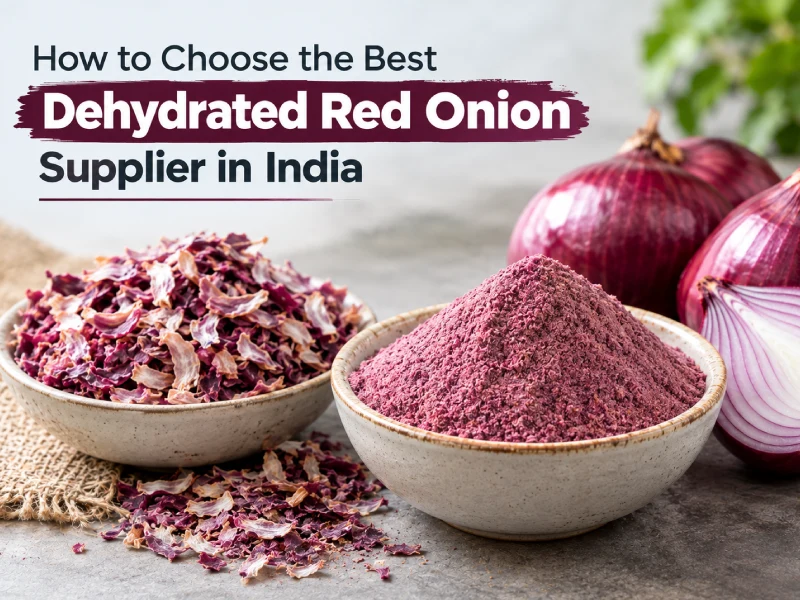
Finding the right Dehydrated Red Onion Supplier in India is important for food manufacturers, snack companies, HoReCa businesses and exporters that depend on consistent flavour and quality. Dehydrated red onion can be supplied as flakes, minced pieces, granules or powder, with each form suited to different applications.
Before placing a bulk order, buyers should evaluate more than price. Product specifications, raw material quality, processing controls, packaging, traceability and the supplier’s ability to maintain consistency all matter. You can explore Dehydrated Red Onion to understand the product range and possible applications.
Why Supplier Selection Matters
Fresh onions naturally vary in moisture, size, flavour and quality. Dehydration reduces moisture and creates a more convenient ingredient but the quality of the final product still depends heavily on raw material and processing.
For commercial buyers, inconsistent dried red onion can create problems such as:
- Uneven flavour across batches
- Variation in colour or appearance
- Different hydration performance
- Poor texture in the finished product
- Difficulties with recipe standardisation
A dependable supplier should therefore provide clear specifications and consistent batches.
7 Things to Check Before Choosing a Supplier
1. Raw Onion Quality and Source
Start by asking where the onions are sourced and what quality parameters are followed before processing.
For buyers interested in Dehydrated Onion Mahuva, the region is particularly relevant because Mahuva in Gujarat is well known for onion processing and dehydration. However, location alone should not determine your choice. Raw material controls and processing practices still need to be evaluated.
2. Product Form and Particle Size
Different applications require different forms of dehydrated red onion.
For example:
- Flakes: Suitable for toppings, foodservice and visible onion applications
- Minced: Useful for cooking mixes and processed foods
- Granules: Suitable for seasoning and dry blends
- Powder: Useful where uniform dispersion is required
Always confirm mesh or particle-size specifications before purchasing.
3. Moisture and Quality Specifications
Moisture is an important consideration for dehydrated ingredients because excess moisture can affect storage stability and texture.
Ask the supplier for a technical specification covering relevant parameters such as moisture, colour, particle size, microbiological requirements and other agreed quality criteria.
Do not rely solely on visual inspection.
4. Processing and Hygiene Controls
A professional supplier should have defined procedures for cleaning, preparation, dehydration, sorting, sizing, quality checking and packaging.
The FSSAI’s hygiene requirements for food businesses provide a useful reference for food-safety practices, including hygiene and good manufacturing practices.
For international buyers, destination-country requirements may also need to be incorporated into the purchasing specification.
5. Batch Consistency and Traceability
One good sample does not automatically mean every future shipment will perform the same way.
Ask how the supplier manages:
- Batch identification
- Production records
- Quality testing
- Raw material traceability
- Retention samples
- Customer specifications
This is particularly important for private-label brands and food manufacturers producing large volumes.
6. Packaging and Storage
Even a properly dehydrated product can lose quality if packaging does not protect it from moisture and contamination.
Discuss packaging size and material according to your storage period, transportation route and application. Buyers should also confirm recommended storage conditions and shelf-life.
7. Ability to Handle Bulk Orders
A bulk dehydrated red onion supplier should be able to communicate realistic production and dispatch timelines.
Before finalising a supplier, clarify:
- Minimum order quantity
- Available pack sizes
- Production capacity
- Lead time
- Shipping arrangements
- Export documentation, where applicable
This helps prevent supply interruptions when demand increases.
How to Compare Dehydrated Onion Manufacturers in India
When comparing dehydrated onion manufacturers in India, look beyond price. Check raw material quality, product type, moisture, colour, size, hygiene, batch consistency, packaging, traceability, MOQ, production capacity and delivery timelines.
For export requirements, also confirm documentation and supplier support. A clear checklist helps procurement teams compare suppliers fairly and avoid quality or supply issues later.
Why Sample Testing Should Come Before Bulk Procurement
A practical way to evaluate a dehydrated red onion supplier is to test the sample in your actual production process.
Check:
- Appearance after cooking
- Aroma and flavour
- Hydration behaviour
- Texture
- Colour after processing
- Mixing performance
- Finished-product consistency
A sample that looks good on its own may behave differently inside a seasoning, snack, sauce, soup or ready-to-eat formulation.
Final Thoughts
Choosing the right Dehydrated Red Onion Supplier in India means looking beyond price. Consider raw material quality, particle size, moisture, processing standards, traceability, packaging and supply capacity.
For food manufacturers, HoReCa businesses, private-label brands and exporters, Chhatariya Foods Pvt. Ltd. can be considered for consistent dehydrated red onion supply. Request samples, check specifications, test the product and confirm supply terms before placing regular bulk orders.
FAQ
1. How do I choose a dehydrated red onion supplier in India?
Compare suppliers based on raw material quality, product specifications, moisture, particle size, processing controls, microbiological testing, packaging, traceability, production capacity and lead times. Always request a sample and test it in your actual food application before committing to regular or bulk procurement.
2. What should I check when buying bulk dehydrated red onion?
When buying bulk dehydrated red onion, check the onion source, product form, particle size, moisture specification, colour, flavour, microbiological parameters, packaging, shelf-life, storage conditions, minimum order quantity and batch traceability. These factors can directly influence product performance and supply consistency.
3. Why is Mahuva important for dehydrated onion sourcing?
Mahuva in Gujarat is an important centre for onion processing and dehydration. Buyers considering Dehydrated Onion Mahuva should still evaluate individual suppliers based on raw material controls, processing practices, product specifications, testing, packaging and consistency rather than choosing solely because of geographic location.
4. What forms of dried red onion are available for food manufacturers?
Dried red onion can be supplied in several forms, including flakes, minced pieces, granules and powder. Flakes work well for visible toppings, while minced onion, granules and powder can suit processed foods, seasoning blends, sauces, instant foods and other formulations.
5. How can I compare dehydrated onion manufacturers in India?
Compare dehydrated onion manufacturers in India using measurable factors rather than price alone. Review technical specifications, processing controls, testing, batch consistency, packaging, traceability, production capacity, MOQ, lead times and export documentation. Sample testing can help verify performance before placing a larger order.