
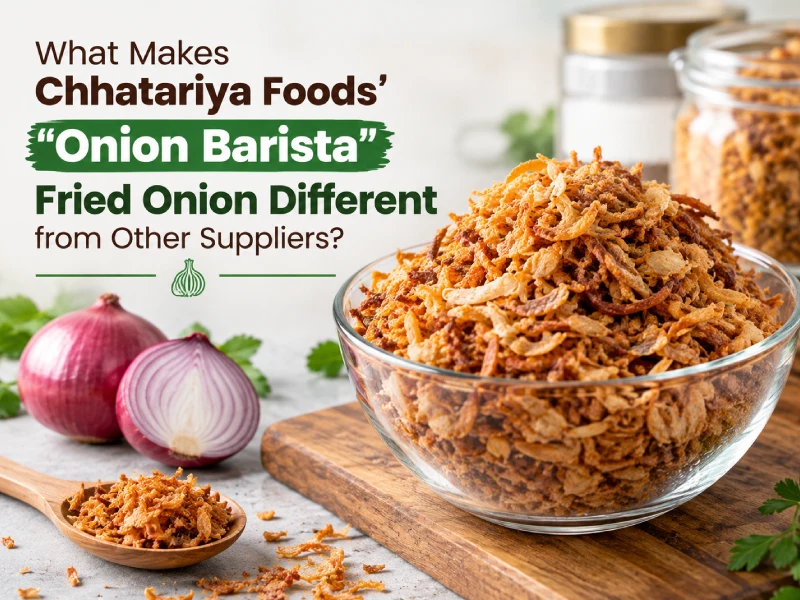
Chhatariya Foods Onion Barista Fried Onion is designed for food businesses that need more than simply a crispy onion ingredient. For commercial kitchens, food manufacturers, snack brands, caterers and exporters, consistency in colour, texture, flavour and handling can directly affect the finished product.
Choosing the right Fried Onion Manufacturer in India therefore means looking at the complete process, not just the quoted price. Raw material selection, cutting, frying, moisture control, quality checks and packaging all influence the final result.
What Is Onion Barista Fried Onion?
“Barista” fried onion refers to thinly sliced onion that is fried to develop a characteristic golden-brown colour, crisp texture and sweet-savoury flavour.
It is commonly used as a topping, garnish, flavour ingredient, or inclusion in prepared foods. The product can save commercial kitchens and manufacturers the time and labour involved in preparing fried onions from scratch.
For businesses handling consistent production volumes, a ready-to-use format can also simplify recipe standardisation.
What Makes Chhatariya Foods Onion Barista Different?
1. Focus on Consistent Raw Material
The quality of fried onion begins before frying. Onion variety, maturity, size, moisture and overall raw material condition can influence colour, flavour and frying performance.
A controlled raw-material selection process helps reduce unnecessary variation between production batches.
2. Controlled Slicing
Slice thickness is an important technical factor. If slices are inconsistent, they may not fry uniformly, resulting in a mixture of under-fried and over-browned pieces.
For commercial applications, consistent slicing helps create a more predictable appearance and texture.
3. Frying Control Matters
Frying is not simply about putting onions into hot oil. Time, temperature, oil condition and loading can influence the final product.
Controlled processing helps achieve the desired golden colour and crispness while reducing avoidable batch variation.
This is particularly important for manufacturers that use fried onion as a visible topping or flavour component.
4. Crispness and Handling
A fried onion product needs to retain its intended texture through packing, transportation, storage and final use.
Moisture exposure can affect crispness. This is why appropriate cooling, handling and moisture-protective packaging are important parts of the overall supply process.
5. Suitable for Multiple Food Applications
The product can be used across different food categories, including:
- Biryani and rice preparations
- Gravies and curry products
- Ready-to-eat meals
- Snack and namkeen products
- Sauces and savoury preparations
- Soup and meal mixes
- Catering and restaurant dishes
- Food-service toppings
The required specification may differ depending on whether the onion is being used as a garnish, topping, ingredient or seasoning component.
Fried Onion vs Dehydrated Fried Onion
These terms can sometimes create confusion for buyers.
Fried onion is produced by frying prepared onion slices, while a dehydrated fried onion product involves additional moisture-reduction considerations depending on the specific manufacturing process and specification.
For industrial buyers, the important point is to confirm the exact product specification rather than relying only on the product name.
Parameters such as moisture, crispness, particle size, colour, packaging and shelf-life should be discussed with the supplier before bulk procurement.
Quality Checks Buyers Should Ask About
When evaluating a fried onion manufacturing company, buyers should ask for measurable product specifications.
Useful parameters include:
- Onion variety and source
- Slice dimensions
- Colour specification
- Moisture level
- Texture and crispness
- Oil and frying specifications
- Microbiological parameters
- Packaging format
- Batch traceability
- Shelf-life and storage conditions
This approach helps buyers compare suppliers on actual product performance rather than price alone.
Why Process Transparency Builds Trust
A dependable supplier should be able to explain how the product is processed and what quality parameters are controlled.
For food businesses, documentation and traceability are also important because ingredients move through multiple stages before reaching consumers.
The FSSAI hygiene requirements for food businesses provide a useful regulatory reference for food-safety and hygiene practices, including good hygiene and manufacturing practices.
For an exporter, additional destination-market requirements may also need to be considered before finalising specifications and packaging.
Why Businesses Choose an Experienced Supplier
A best fried onion supplier is not necessarily the one offering the lowest initial quotation. Buyers should consider consistency, production capability, quality documentation, communication, packaging and the ability to maintain agreed specifications across repeat orders.
For international buyers, working with an experienced fried onion exporter India can also simplify discussions around product specifications, shipment quantities, packaging and documentation.
Similarly, an established Indian spices supplier with experience serving food businesses may understand how fried onion fits into broader seasoning and ingredient requirements.
Final Thoughts
The difference between fried onion suppliers often becomes visible in the details: raw material selection, slice uniformity, frying control, moisture management, crispness, packaging and batch consistency.
Chhatariya Foods‘ Onion Barista approach focuses on these practical factors to make fried onion easier to use across food manufacturing, HoReCa, ready-to-eat products, snacks and export applications.
For bulk buyers, the smartest next step is to compare samples against defined specifications and test the product in the actual application before moving to regular procurement.
FAQ
1. What makes Chhatariya Foods Onion Barista Fried Onion different?
Chhatariya Foods Onion Barista Fried Onion focuses on practical quality factors such as raw material selection, slice consistency, frying control, crispness, moisture management and packaging. These factors help food manufacturers and commercial kitchens achieve more predictable results across different production batches and applications.
2. How do I choose the best fried onion supplier in India?
Look beyond price when selecting the best fried onion supplier. Check raw material quality, slice size, colour, moisture, crispness, processing controls, packaging, traceability, documentation and production capacity. Testing samples in your actual recipe can also help confirm whether the product meets your requirements.
3. What are the applications of fried onion for food manufacturers?
Fried onion can be used in biryani, rice dishes, gravies, ready-to-eat meals, snacks, namkeen, sauces, soup mixes, savoury products and food-service preparations. The required specification may change depending on whether the onion is used as a topping, garnish, ingredient, or flavour component.
4. Is dehydrated fried onion different from regular fried onion?
The terms can refer to products with different processing and moisture specifications, so buyers should confirm the supplier’s technical specification. Moisture, texture, particle size, colour, packaging and shelf-life can affect how a fried onion product performs during storage and its final food application.
5. What should I check before buying fried onion in bulk?
Bulk buyers should check onion source, slice dimensions, colour, moisture, crispness, frying specifications, microbiological parameters, packaging, batch traceability, shelf-life and storage requirements. A sample evaluation is recommended before large procurement, particularly when fried onion is a visible component of the finished product.
6. Can fried onion suppliers support export requirements?
Yes, experienced fried onion suppliers and exporters can support commercial export orders, but buyers should confirm destination-specific requirements before ordering. Product specifications, packaging, documentation, lab reports, shelf-life and applicable food regulations should be agreed upon before shipment.