
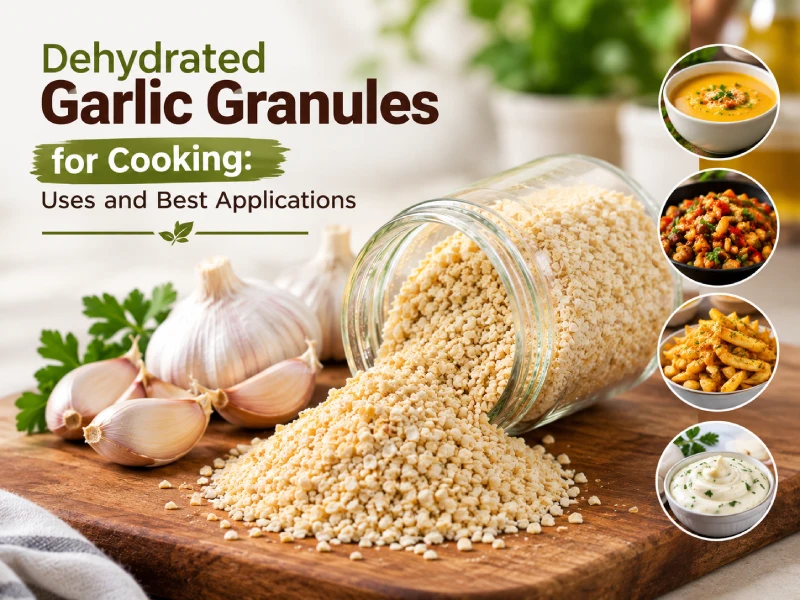
Dehydrated Garlic Granules for Cooking offer a practical way to add garlic flavour without the preparation, moisture and short shelf life associated with fresh garlic. For food manufacturers, restaurants, cloud kitchens, seasoning brands and exporters, granules provide consistent particle size and easy handling.
For businesses comparing Dehydrated Garlic Granules, the right grade depends on the final application. Size, moisture, flavour strength, packaging and storage conditions can all affect performance.
What Are Dehydrated Garlic Granules?
Dehydrated garlic granules are produced by cleaning, processing, drying and sizing fresh garlic into small, uniform particles. Unlike fresh garlic, the reduced moisture content makes the product easier to store, transport, weigh and use in commercial food preparation.
Granules are different from garlic powder. Powder has a much finer particle size, while granules offer more visible texture and controlled release of garlic flavour.
This makes granulated garlic useful in products where manufacturers want both flavour and some textural presence.
Best Applications of Dehydrated Garlic Granules
1. Spice and Seasoning Blends
Garlic granules work well in dry seasoning mixes for snacks, fries, chips, instant foods and ready-to-cook products.
They can be combined with salt, chilli, onion, herbs, pepper and other ingredients to create consistent seasoning formulations.
2. Snacks and Namkeen
Snack manufacturers can use dried garlic granules in flavour blends for namkeen, savoury mixtures, roasted snacks and coated products.
Their dry format makes them convenient for blending with other powdered or granular ingredients during seasoning.
3. Sauces and Ready-to-Cook Foods
Garlic granules can be incorporated into sauces, gravies, marinades, soup mixes and ready-to-cook meals where garlic flavour is required.
The appropriate particle size should be selected according to the product’s processing method and desired mouthfeel.
4. Restaurants, Hotels and Cloud Kitchens
Commercial kitchens can use granules when they need a convenient garlic ingredient without repeatedly peeling and chopping fresh cloves.
They are particularly useful for bulk food preparation because the ingredient can be measured according to a standard recipe, helping kitchens maintain consistency.
5. Instant Food Products
Instant noodles, soup premixes, pasta seasoning, rice mixes and other convenience foods can use garlic granules as part of their flavour system.
For dry mixes, manufacturers should consider particle size and flow characteristics so the garlic distributes evenly throughout the formulation.
6. Meat, Marinade and Savoury Products
Garlic granules are also suitable for marinades, meat seasonings, savoury fillings and processed food formulations.
The granule size can influence how quickly flavour becomes available during cooking, so application testing is useful before large-scale procurement.
Why Particle Size Matters
One common mistake when sourcing granulated garlic is choosing a product based only on price.
Particle size can influence:
- Mixing uniformity
- Flavour distribution
- Hydration behaviour
- Product appearance
- Processing performance
- Final mouthfeel
A food manufacturer should therefore communicate the intended application to the supplier before selecting a grade.
For example, a seasoning blend may require a different specification from a product where visible garlic pieces are part of the finished appearance.
What Should Buyers Check Before Ordering?
When evaluating Dehydrated Garlic Manufacturers, buyers should look beyond the product name. Ask for specifications and confirm whether the supplier can consistently meet them.
Important checks include:
- Garlic variety and origin
- Moisture specification
- Granule size or mesh
- Colour and appearance
- Aroma and flavour profile
- Microbiological parameters
- Packaging format
- Batch traceability
- Storage recommendations
- Available documentation
A reliable dehydrated garlic supplier should be able to explain these specifications clearly and provide consistent batch information.
For Indian and international buyers, supplier documentation is particularly important when the ingredient is being used in commercial food production or exported products.
How to Store Garlic Granules Properly
Even dehydrated ingredients need suitable storage. Keep the product in its original sealed packaging and protect it from moisture, heat, direct sunlight and contamination.
Once opened, reseal the pack properly after each use. Poor storage can affect aroma, texture and overall product quality.
For food businesses, following the supplier’s recommended storage conditions is a simple way to reduce avoidable quality problems.
Choose Suppliers With Process Transparency
The quality of granulated garlic depends on more than the drying stage. Raw material selection, cleaning, processing, sizing, quality checks, packaging and storage all contribute to the final ingredient.
This is why businesses should evaluate Dehydrated Garlic Manufacturers based on their process controls and ability to maintain consistent specifications rather than selecting purely on the lowest quoted price.
Food businesses can also refer to FSSAI’s food safety and hygiene requirements when reviewing food-safety practices and supplier expectations.
For an Indian food business, working with an experienced Indian spices supplier that understands commercial applications can make sourcing and specification management easier.
Final Takeaway
Dehydrated garlic granules are a practical ingredient for snacks, seasonings, sauces, instant foods, marinades, restaurants, and large-scale food production. Their dry format makes handling, storage, and formulation easier while supporting consistent results across batches.
The right grade depends on the application, particle size, quality standards, packaging, and supplier reliability. Chhatariya Foods Pvt. Ltd. supplies dehydrated garlic products for different food applications, helping businesses source consistent ingredients for bulk requirements.
FAQ
1. Are dehydrated garlic granules good for cooking?
Yes. Dehydrated garlic granules are suitable for cooking, seasoning blends, sauces, soups, marinades, snacks and ready-to-cook foods. They provide convenient garlic flavour while being easier to measure, store and handle than fresh garlic, making them useful for both commercial kitchens and food manufacturers.
2. What are the main uses of dehydrated garlic granules?
The main uses include snack seasoning, namkeen, sauces, instant noodles, soup mixes, marinades, ready meals, savoury foods and spice blends. Food manufacturers can select different granule sizes depending on whether they need visible garlic pieces, controlled texture, or uniform distribution.
3. How do I choose a reliable dehydrated garlic supplier?
Look for a dehydrated garlic supplier that provides clear specifications for moisture, particle size, microbiological quality, packaging, traceability and storage. Buyers should also assess processing controls, batch consistency, documentation and the supplier’s ability to meet commercial volume requirements.
4. Are garlic granules the same as dried garlic powder?
No. Both are forms of dried garlic, but their particle sizes differ. Garlic powder is finely ground, while garlic granules are larger particles. Granules can provide more texture and may behave differently during blending, hydration, cooking and processing.
5. What should food manufacturers check when buying garlic granules?
Food manufacturers should check garlic origin, moisture level, particle size, colour, aroma, flavour, microbiological specifications, packaging, shelf-life information and batch traceability. Application testing is also recommended because the required granule specification can vary between seasoning, sauces, snacks and ready-meal formulations.
6. Can dehydrated garlic granules be used in seasoning blends?
Yes. Dehydrated garlic granules are widely suitable for dry seasoning formulations. They can be blended with onion, chilli, salt, herbs, pepper and other ingredients. The selected particle size should allow uniform mixing and appropriate distribution throughout the finished seasoning.