
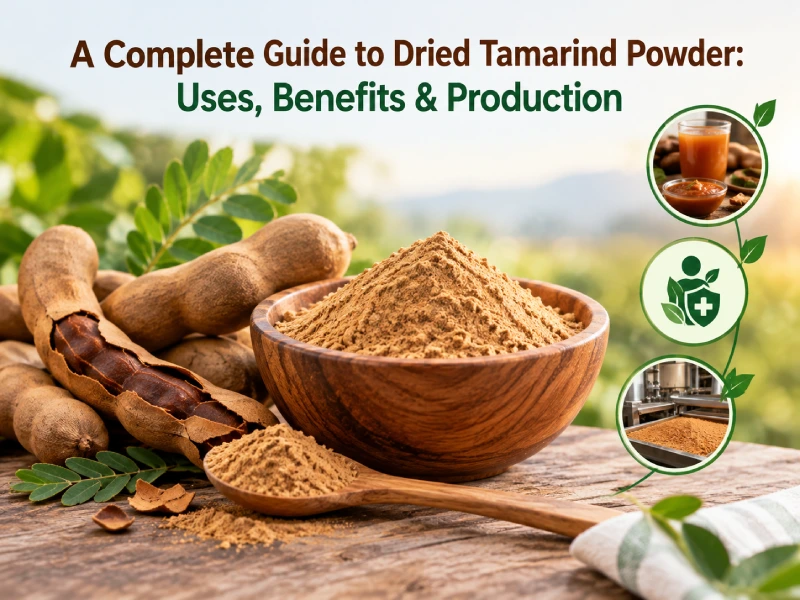
Dried Tamarind Powder Uses & Benefits are becoming increasingly relevant to food manufacturers looking for convenient ingredients with a distinctive sour and tangy profile. Tamarind powder can bring acidity and flavour to seasoning blends, sauces, snacks, instant foods, beverages and prepared recipes.
For businesses sourcing from vegetable powder suppliers, the right product should match the application, flavour profile, particle size, moisture specification and packaging requirements. A good purchasing decision starts with understanding how the powder is produced and where it performs best.
What Is Dried Tamarind Powder?
Dried tamarind powder is produced by processing tamarind pulp into a dry, powdered ingredient. The objective is to create a convenient format that can be measured, blended, packed and incorporated into different food formulations.
Tamarind is traditionally valued for its acidic pulp and distinctive flavour. The Food Safety and Standards Authority of India (FSSAI) recognizes tamarind pulp, puree and concentrate as food products and specifies quality parameters such as total soluble solids and minimum acidity.
For commercial buyers, however, flavour is only one part of the specification. Consistency from batch to batch is equally important.
Key Uses of Dried Tamarind Powder
1. Spice and Seasoning Blends
Tamarind powder works well in savoury seasoning formulations where a tangy note is required. It can be blended with chilli, cumin, coriander, salt, herbs and other spices.
This makes it useful for snack seasonings, namkeen blends, chutney-style powders and regional spice formulations.
2. Sauces, Chutneys and Condiments
Food manufacturers can use the powder to develop tamarind-based sauces, chutneys, dips, marinades and condiment mixes.
Its dry format can simplify formulation because the ingredient can be weighed and blended directly into a controlled recipe.
3. Snacks and Namkeen
Tamarind flavour is particularly useful in savoury snacks where manufacturers want a sweet-sour or tangy profile.
It can be incorporated into seasoning systems for coated snacks, namkeen, savoury mixes and other ready-to-eat products. The appropriate particle size depends on the blending and application process.
4. Instant and Convenience Foods
Instant soup mixes, ready-to-cook products, spice premixes and other convenience foods can use tamarind powder as part of a broader flavour system.
For manufacturers, a dry ingredient can be easier to handle during batching than fresh tamarind pulp, particularly when production requires precise weighing and repeatable formulations.
5. Beverage and Drink Mixes
Tamarind has applications in beverage flavouring, including traditional and tropical-style drinks.
For powdered beverage products, manufacturers need to test solubility, acidity, flavour intensity, colour and interaction with other ingredients before finalising the formulation.
Practical Benefits for Food Manufacturers
The main commercial advantage of dried tamarind powder is ingredient convenience. A powdered format can be stored, measured, transported and incorporated into dry blends without handling fresh tamarind pulp during every production cycle.
Other practical advantages include:
- Easy integration into dry formulations
- Consistent dosing during batch production
- Convenient bulk handling
- Suitable for seasoning and premix development
- Flexible use across food categories
- Easier incorporation into private-label formulations
These benefits depend on the actual product specification, so buyers should conduct application trials rather than assuming every powder will perform identically.
How Is Dried Tamarind Powder Produced?
A typical production process begins with suitable tamarind material and careful raw-material inspection.
Step 1: Raw Material Selection
Good-quality tamarind is selected according to the required flavour and processing specifications. Raw material condition can directly influence the aroma, acidity, colour and overall quality of the finished powder.
Step 2: Cleaning and Preparation
The material is cleaned and prepared to remove unwanted matter before further processing. Controlled handling is important because the final powder is intended for food manufacturing.
Step 3: Drying and Powdering
The prepared tamarind material is processed to reduce moisture and converted into a powder of the required fineness.
The exact processing parameters should be controlled according to the product specification and intended application.
Step 4: Sieving and Quality Checks
The powder can then be sieved for particle consistency and checked against agreed quality parameters. Depending on the buyer and market, testing may cover moisture, microbiological parameters, foreign matter and other relevant specifications.
Step 5: Packaging
Moisture-protective packaging is important for maintaining the condition of a dry powder during storage and transportation. Export and bulk buyers should also confirm packaging sizes and shipment requirements before ordering.
How to Choose the Best Dried Tamarind Powder
If you are searching for where to buy dried tamarind powder, do not compare suppliers on price alone.
Ask for:
- Product specification and particle size
- Raw-material information
- Moisture requirements
- Quality and testing documentation
- Packaging details
- Batch traceability
- Minimum order quantity
- Sample availability
- Bulk supply capability
A reliable dehydrated tamarind powder manufacturer should be able to explain its specifications clearly and provide samples for application testing.
Why Supplier Capability Matters in Bulk Purchasing
The vegetable powder market in India serves food processors, seasoning manufacturers, HoReCa businesses, exporters, private-label brands and other commercial buyers. As product applications become more specific, buyers increasingly need suppliers who can provide consistent specifications rather than generic powders.
For long-term procurement, evaluate the supplier’s processing controls, documentation, communication, packaging and ability to maintain the agreed product specification across repeat orders.
Final Takeaway
Dried tamarind powder gives food manufacturers a convenient way to add a distinctive tangy flavour to seasonings, snacks, sauces, instant foods, beverages and other food formulations. Selecting the right powder requires attention to application performance, raw-material quality, processing, particle size, moisture, packaging, documentation and supply consistency.
Chhatariya Foods Pvt. Ltd., one of the vegetable powder manufacturers in India, offers processed food ingredients for commercial applications, helping businesses source consistent powders suited to their production requirements.
FAQ
1. What are the main dried tamarind powder uses in food manufacturing?
Dried tamarind powder is commonly used in spice blends, snack seasonings, namkeen, sauces, chutneys, marinades, instant foods, beverage mixes and ready-to-cook products. Its dry format makes it convenient for controlled dosing and blending, but manufacturers should select particle size and flavour strength according to their specific formulation.
2. Where can food businesses buy dried tamarind powder in bulk?
Food businesses should source dried tamarind powder from established ingredient or vegetable powder suppliers that can provide clear specifications, quality documentation, suitable packaging, samples and consistent bulk supply. Buyers should test a sample in their actual formulation before committing to a large commercial order or long-term supply arrangement.
3. How do I choose a dehydrated tamarind powder manufacturer?
Compare manufacturers based on raw-material quality, processing controls, particle-size consistency, moisture specification, testing, packaging, traceability, production capacity and communication. A dependable dehydrated tamarind powder manufacturer should also be able to explain its product specification and provide samples for application testing when required.
4. Is dried tamarind powder suitable for seasoning blends?
Yes, dried tamarind powder can be used in seasoning blends to provide a distinctive tangy flavour. It can be combined with chilli, cumin, coriander, salt, herbs and other ingredients. Manufacturers should test the powder’s acidity, flavour intensity, particle size and blending behaviour before finalising a commercial seasoning formulation.
5. What should I check when buying the best dried tamarind powder?
Check the raw material, flavour profile, colour, particle size, moisture specification, testing documentation, packaging, traceability and supplier consistency. The “best” powder depends on the intended application, so a sample trial is important. A powder suitable for chutney may require different characteristics from one used in seasoning.