
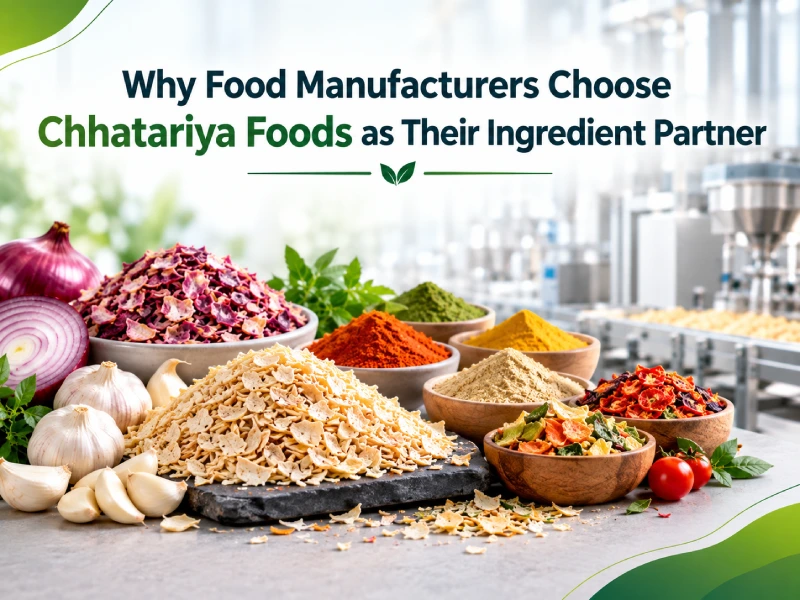
Choosing a Food Ingredient Manufacturer in India is an important procurement decision for food processors, seasoning companies, HoReCa businesses, exporters and private-label brands. The right partner needs to provide more than individual products it should offer consistent specifications, dependable supply, suitable packaging and clear communication.
Chhatariya Foods supports businesses looking for a Spices Manufacturer in India while also offering a wider range of dehydrated food ingredients, vegetable powders, fried ingredients and seasoning products. This broader portfolio can simplify sourcing when multiple ingredients are required from one manufacturing partner.
What Food Manufacturers Need From an Ingredient Partner
Ingredient procurement becomes more demanding as production volumes increase. A product that works for a small trial must also perform consistently across repeated commercial batches.
Food manufacturers typically look for:
- Consistent product specifications
- Reliable raw-material sourcing
- Controlled processing
- Quality and food-safety checks
- Bulk supply capability
- Suitable packaging
- Batch traceability
- Responsive commercial support
These factors can directly impact formulation consistency, production planning and procurement efficiency.
1. A Broad Range of Food Ingredients
One advantage of working with an established Food Ingredient supplier is the ability to source multiple categories through one relationship.
Chhatariya Foods’ product portfolio includes ingredients such as:
- Dehydrated onions
- Dehydrated garlic
- Dehydrated ginger
- Fried onion
- Fried garlic
- Vegetable powders
- Fruit powders
- Indian spices
- Seasoning masala
- Instant soup premixes
For food processors and seasoning manufacturers, this can make ingredient planning more straightforward, particularly when several components are needed for the same product line.
For More Details About Products: Click Here
2. Focus on Dehydrated Ingredients and Powders
Dehydrated ingredients are widely used where manufacturers need convenient handling, controlled dosing and easier storage compared with fresh raw materials.
Different formats can serve different applications. For example, flakes, minced ingredients, granules and powders may be selected according to the recipe, mixing process and desired finished-product characteristics.
As a supplier, the important point is not simply having multiple formats available. Buyers should be able to understand the relevant product specifications and select the format that fits their application.
3. Quality Starts With Raw Material Selection
A finished ingredient can only perform as well as the raw material and processing controls behind it.
For products such as onion, garlic, ginger and vegetable powders, manufacturers should pay attention to raw-material condition, processing consistency, moisture control, appearance and microbiological quality.
This is especially important for businesses purchasing ingredients in bulk because variation between batches can create formulation and production challenges.
The Food Safety and Standards Authority of India (FSSAI) provides regulatory requirements and guidance for food businesses, including areas related to food safety, hygiene and manufacturing practices. FSSAI is therefore an important reference point when evaluating food-ingredient suppliers in India.
4. One Partner for Multiple Applications
Different food businesses have different ingredient requirements.
Food Processing Companies
Manufacturers can use dehydrated vegetables, powders, spices and seasonings across ready-to-eat, instant and processed food products.
Snack and Seasoning Businesses
Powders, dehydrated onion and garlic, spices and custom blends can be used to develop savoury seasoning systems.
HoReCa and Commercial Kitchens
Convenient dry ingredients can support repeatable preparation across restaurants, catering operations and institutional kitchens.
Retail and D2C Brands
Private-label businesses may need consistent ingredients, suitable packaging and dependable replenishment as product demand grows.
Exporters and International Buyers
Export-oriented buyers need reliable specifications, packaging and documentation that support their destination-market requirements.
5. Bulk Supply Matters as Businesses Grow
Supplier selection should consider future requirements, not just today’s order.
A manufacturer may successfully supply a small trial but struggle to maintain availability when monthly demand increases. Before entering a long-term agreement, buyers should discuss:
- Minimum order quantities
- Production capacity
- Lead times
- Packaging formats
- Dispatch schedules
- Repeat-order consistency
- Documentation requirements
For wholesalers and manufacturers, predictable supply can make production planning much easier.
6. Practical Support During Product Selection
A good ingredient partnership should involve more than sending a quotation.
Before approving an ingredient, buyers should be able to discuss the intended application and evaluate whether the selected product specification is suitable.
A practical procurement process can include:
- Define the application – Explain the finished product and processing method.
- Review specifications – Check moisture, particle size, flavour, colour and other relevant parameters.
- Test a sample – Evaluate performance in the actual formulation.
- Confirm packaging – Ensure the format suits storage and production requirements.
- Approve the specification – Document the agreed requirements for repeat orders.
This approach helps reduce surprises after commercial production begins.
Why This Matters for Long-Term Procurement
For food manufacturers, changing suppliers frequently can create unnecessary quality and production challenges. A stable ingredient partner can help businesses maintain agreed specifications while simplifying procurement.
This is why companies comparing Vegetable Powder Manufacturers in India, spices suppliers or dehydrated ingredient producers should look beyond catalogue size and pricing.
The more useful questions are:
- Can the supplier maintain consistent quality?
- Can it support increasing volumes?
- Are specifications clearly documented?
- Is communication straightforward?
- Can the products fit different applications?
- Does the supplier understand commercial food production requirements?
Chhatariya Foods as an Ingredient Partner
Chhatariya Foods brings together dehydrated vegetables, garlic, onion, ginger, powders, spices, fried ingredients and seasoning products under one manufacturing portfolio.
For food processors, wholesalers, exporters and brands, this can provide a practical sourcing option when multiple food ingredients are required. The focus should remain on application suitability, agreed specifications, quality controls and dependable supply.
Rather than choosing a top spices company in India based only on a marketing claim, buyers should evaluate the actual evidence: product samples, specifications, testing, manufacturing capability, communication and consistency over time.
Final Takeaway
The right Food Ingredient Manufacturer in India should support both product quality and procurement reliability. For growing food businesses, factors such as raw-material control, processing, product range, documentation, bulk capacity and application suitability matter as much as the quoted price.
Chhatariya Foods offers a broad ingredient portfolio for businesses sourcing dehydrated products, vegetable powders, spices, fried ingredients and seasoning solutions. Buyers can make the final decision by evaluating samples, specifications and supply requirements against their own production needs.
FAQ
1. What should I look for in a Food Ingredient Manufacturer in India?
Look for consistent product specifications, controlled processing, quality testing, reliable raw-material sourcing, suitable packaging and dependable supply capacity. Buyers should also request samples and relevant documentation before bulk procurement. Evaluating the ingredient in the intended application provides stronger evidence than comparing suppliers based only on price.
2. What products can a Food Ingredient supplier provide?
A Food Ingredient supplier may offer dehydrated vegetables, onion, garlic, ginger, vegetable and fruit powders, spices, fried ingredients and seasoning blends. The available range varies by manufacturer. Buyers should check product specifications, formats, minimum order quantities and application suitability before selecting products for commercial production.
3. How do I compare Vegetable Powder Manufacturers in India?
Compare manufacturers based on raw-material quality, processing controls, product specifications, testing, packaging, production capacity and supply consistency. Request samples and evaluate the powder in your actual formulation. For long-term procurement, also review lead times, documentation, batch traceability and the supplier’s ability to meet recurring volumes.
4. Can food manufacturers buy spices and dehydrated ingredients from one supplier?
Yes, some manufacturers offer both spice products and dehydrated ingredients. Sourcing multiple categories from one supplier can simplify procurement, but each product should still be evaluated against its individual specifications. Buyers should confirm quality parameters, packaging, availability and application performance before consolidating their ingredient purchases.
5. How should I evaluate a Spices supplier in India?
Evaluate the supplier’s raw-material sourcing, processing practices, product specifications, testing, packaging, traceability and production capacity. Ask for samples and relevant documentation, then assess the product in the finished application. For export orders, also confirm destination-market requirements before approving the commercial specification.
6. Why is batch consistency important for food manufacturers?
Batch consistency helps manufacturers maintain the expected flavour, colour, texture and performance of their finished products. Significant variation in an ingredient can require recipe adjustments or affect production results. Establishing clear product specifications and checking repeat batches can help reduce these risks during long-term procurement.